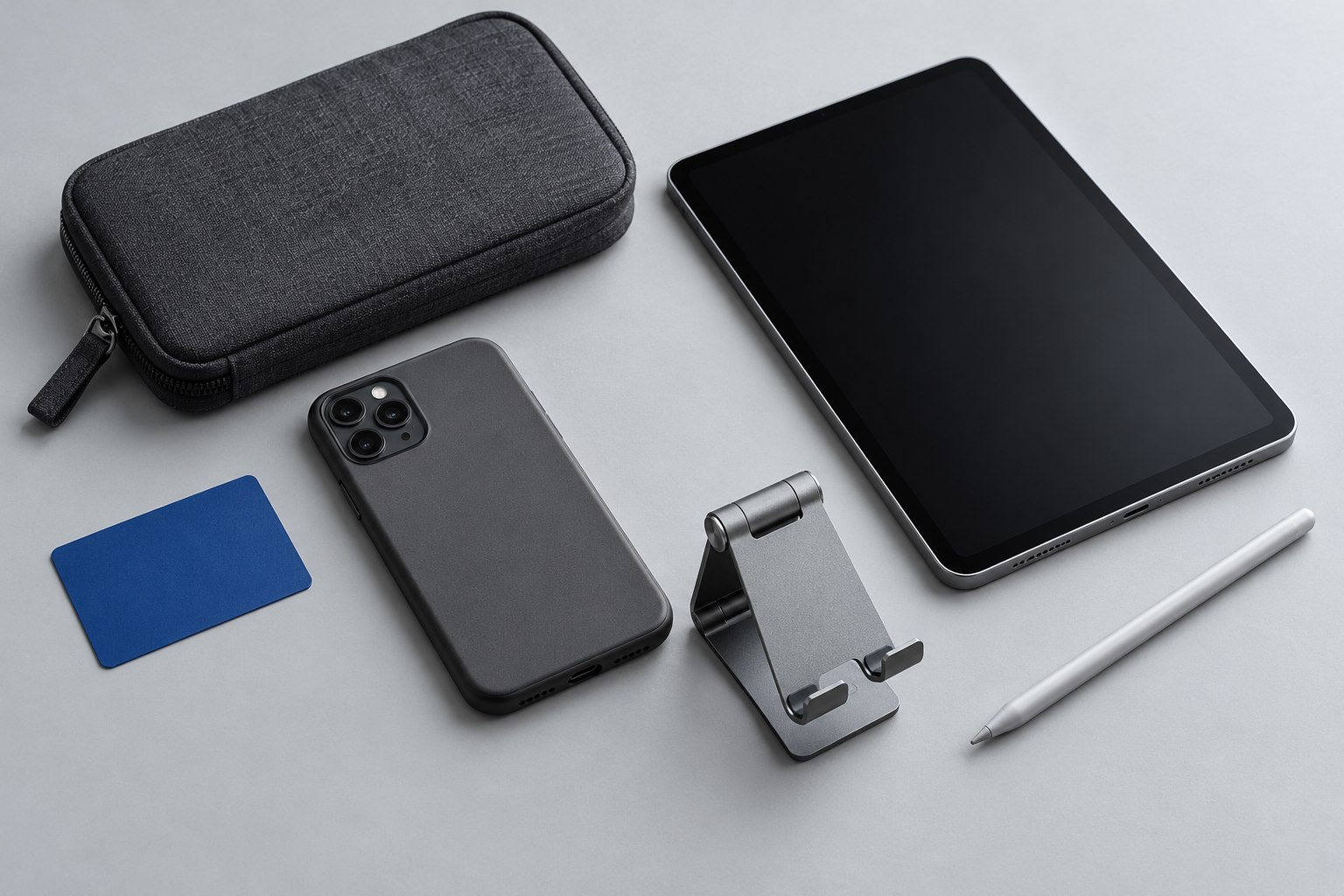
Lay out one actual journey
A useful travel pouch starts with the devices and tasks on the itinerary. A weekend with a phone and e-reader needs a different kit from a week of camera work. Lay out the items you expect to use, then separate essentials from backup pieces. An organizer with many pockets can encourage carrying objects that have no job.
Group by when you need access. A ticket-related phone accessory should not be buried under spare straps and lens caps. A storage card used during daily photo offload deserves a fixed compartment. The pouch should make the important item easy to find without emptying everything onto a crowded seat.
Choose space for the shapes
Depth is often more important than the published length and width. A hard lens case, folding stand, and bulky adapter may each fit alone while making the pouch impossible to close together. Check the internal dimensions and allow room for padded divisions.
Use elastic loops for items they hold comfortably, rather than stretching them around an oversized object. Tight loops can press buttons or strain small hinges. Rigid compartments suit tiny parts such as pen tips and memory cards; soft flat pockets suit a cleaning cloth or thin stand.
Keep sharp or gritty objects away from lenses and displays. Keys should have their own place outside the delicate-accessory section. A pouch lining cannot prevent every mark if hard objects are packed tightly enough to rub during travel.
Give temperature and moisture some thought
Do not pack a device while it is wet or unusually warm. Let it return to a suitable condition before closing the pouch. Apple’s temperature guidance warns against leaving phones in hot cars; a padded organizer does not turn that environment into safe storage.
If you expect rain, distinguish a water-resistant outer fabric from a waterproof sealed compartment. Zippers and seams may admit water even when the fabric sheds droplets. Use protection suited to the journey and keep the pouch out of obvious spill zones.
Avoid storing damp cloths alongside electronics. A cloth used to wipe a screen should dry separately before returning to the kit. Moisture trapped inside a closed pocket can remain there long after the outside of the bag looks dry.
Use a repeatable packing order
Put the least-used pieces in the deepest compartment, then add daily tools where they are visible. Choose one place for each small part. A quick visual check should tell you whether the card reader, stylus, or phone stand is missing.
A simple inventory can be a note on the phone or a small card inside the pouch. Include quantities where identical items matter. For example, two camera cards with distinct labels are easier to account for than a loose stack of visually similar cards.
Do not label the outside with passwords or account recovery details. If you add a contact label, use only the information you are comfortable making visible to a finder.
Reduce after the first trip
At the end of a journey, separate items used every day, items used once for a real need, and items never used. Keep a sensible backup where failure would be disruptive, but remove duplicates that solve no distinct problem. The goal is not the smallest possible kit; it is a kit you can explain.
Check the pouch for torn lining, loose zipper teeth, and stretched elastic. Replace worn dividers before a small part disappears through a gap. Clean it according to its material instructions and let it dry completely.
An organized pouch earns its space when unpacking takes seconds and repacking leaves no uncertainty. A handful of correctly sized compartments, chosen around your routine, often works better than a dense grid of pockets that hide what you brought.
Sources & further detail
These references support the technical context. Examples and selection advice are editorial explanations; verify the documentation for your exact equipment and software.
A detail we should revisit? Send the guide URL and the relevant documentation to SmithKent5791@outlook.com.
Read the editorial policy